Kinetic plasma turbulence is my primary research interest, with an emphasis on high-performance computational studies of turbulence in space and astrophysical plasmas using the Astrophysical Gyrokinetics code, AstroGK. My broader research program involves the coordinated use of analytical theory, numerical simulations, spacecraft observations, and laboratory experiments to understand how the kinetic physics of plasma turbulence leads to the energization of particles.

Check out my Blog! Partly Cloudy with a Slight Chance of X-Rays: Space Weather Explained is my ongoing popular science book project to explain space weather to the general public. 
 

Gyrokinetic simulation of an Alfven Wave Collision

Below is a movie of a gyrokinetic simulation of an Alfven Wave Collision, the fundamental building block of astrophysical plasma turbulence.

News

MagnetosphereOverview

American Astronomical Society Press Briefing
Monday, June 7, 2021
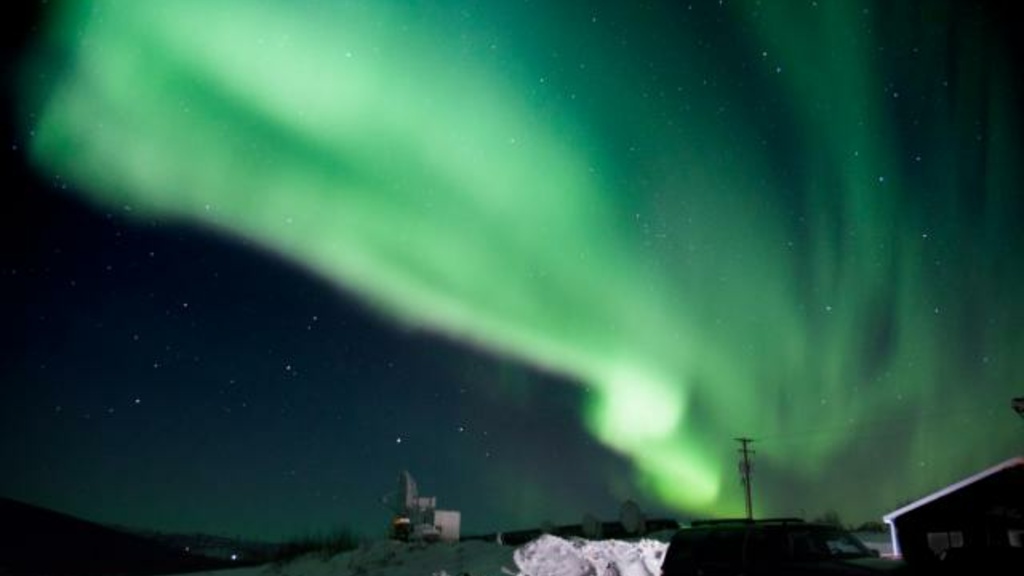
Professor Jim Schroeder (Wheaton College, IL) and Professor Gregory Howes presented the results from their recently published Nature Communications paper, "Laboratory measurements of the physics of auroral electron acceleration by Alfven waves" in a Press Briefing at the 238th Meeting of the American Astronomical Society. This exciting work uses laboratory experiments at UCLA's Large Plasma Device (LAPD) to demonstrate definitively that the physics of electrons surfing on Alfven waves can explain the energetic electrons that precipitate into the ionosphere and denerate discrete auroral arcs during geomagnetic storms.

'Low probability, high impact' - Assessing solar threat to the power grid

Wednesday, April 21, 2021
The local CBS (KGAN) and Fox (KFXA) affiliates ran a news segment on the threat of solar flares and geomagnetic storms to our power grid, featuring a number of quotes from Gregory Howes.
Aurora space station NASA

Graduate student Jim Schroeder's research highlighted in Physics Today

Thursday, March 16, 2017
"A step toward deciphering auroras" Electrons get jolted by the plasma waves that are thought to drive the colorful phenomenon.

Gregory Howes wins inaugural Ronald C. Davidson Award for Plasma Physics

Tuesday, October 25, 2016
A weakened cascade model for turbulence in astrophysical plasmas

Research Group

Howes_Gregory
Pinned content, custom sorted.

Gregory G. Howes, Ph.D.

Title/Position
Associate Professor
Kinetic plasma turbulence is my primary research interest, with an emphasis on high-performance computational studies of turbulence in space and astrophysical plasmas using the Astrophysical Gyrokinetics code, AstroGK. My broader research program involves the coordinated use of analytical theory, numerical simulations, spacecraft observations, and laboratory experiments to understand how the kinetic physics of plasma turbulence leads to the energization of particles.
Collin Brown

Colin Brown

Title/Position
Graduate Research Assistant
Third year graduate student working on particle acceleration and plasma heating in collisionless shocks using the field-particle correlation technique.
Horvath, Sarah

Sarah Horvath

Title/Position
Graduate Research Assistant
Sarah Horvath does research in computational space plasma physics. This includes running high-resolution simulations of turbulent solar wind plasma in order to better understand the process of Landau damping by electrons: a mechanism that contributes to the heating of the solar wind as it expands outward from the Sun. Characterizing this mechanism within simulations can provide theoretical framework for interpreting data from current and future spacecraft missions.
Huang, Rui

Rui Huang, Graduate Assistant

Rui Huang is interested in theoretical and computational astrophysics. Shes is currently working with Prof. Howes on a project studying the plasma turbulence theory.
Andrew McCubbin

Andrew McCubbin

Title/Position
Graduate Research Assistant
Andrew’s research focus is using computational techniques to study fundamental plasma physics. His thesis work involves investigating energy transfer mechanisms in collisionless magnetic reconnection. He has developed analysis software and simulation diagnostics to probe properties of astrophysical and heliospheric plasmas to better understand plasma heating processes
Daniel McGinnis

Daniel McGinnis, Ph.D.

Title/Position
Postdoctoral Research Scholar
Peter Montag

Peter Montag

Title/Position
Postdoctoral Research Scholar
Pette, Daniel

Daniel Pette

Title/Position
Graduate Student
Dan is currently employed as an aerospace engineer while he pursues a Ph.D.